The idea
Argyph is a local binary that gives coding agents bounded codebase context without cloud accounts or API keys. Its ask-first retrieval router combines text search, a tree-sitter symbol graph, semantic search, and token-budgeted repository packing behind one MCP endpoint.
The problem
Giving an agent useful repository context often means wiring together multiple servers, processes, and cloud services. That increases setup cost and can move proprietary source outside the developer's machine.
How it works
I built a tiered Rust index that becomes useful immediately: file inventory first, symbol and structural indexes next, then local embeddings in the background. Queries return bounded spans and disclose index coverage so the caller knows what evidence was available.
System
Ask-first local index
One read-only MCP endpoint over a three-tier index, nineteen tools, and bounded span results.
One local index serves exact text matches, structural questions, and semantic retrieval. Results return source spans rather than asking the agent to trust an unsupported summary.
The work
The public v1.0.4 release includes platform binaries and a desktop extension. The repository documents the nineteen tools, indexing stages, and retrieval behavior.
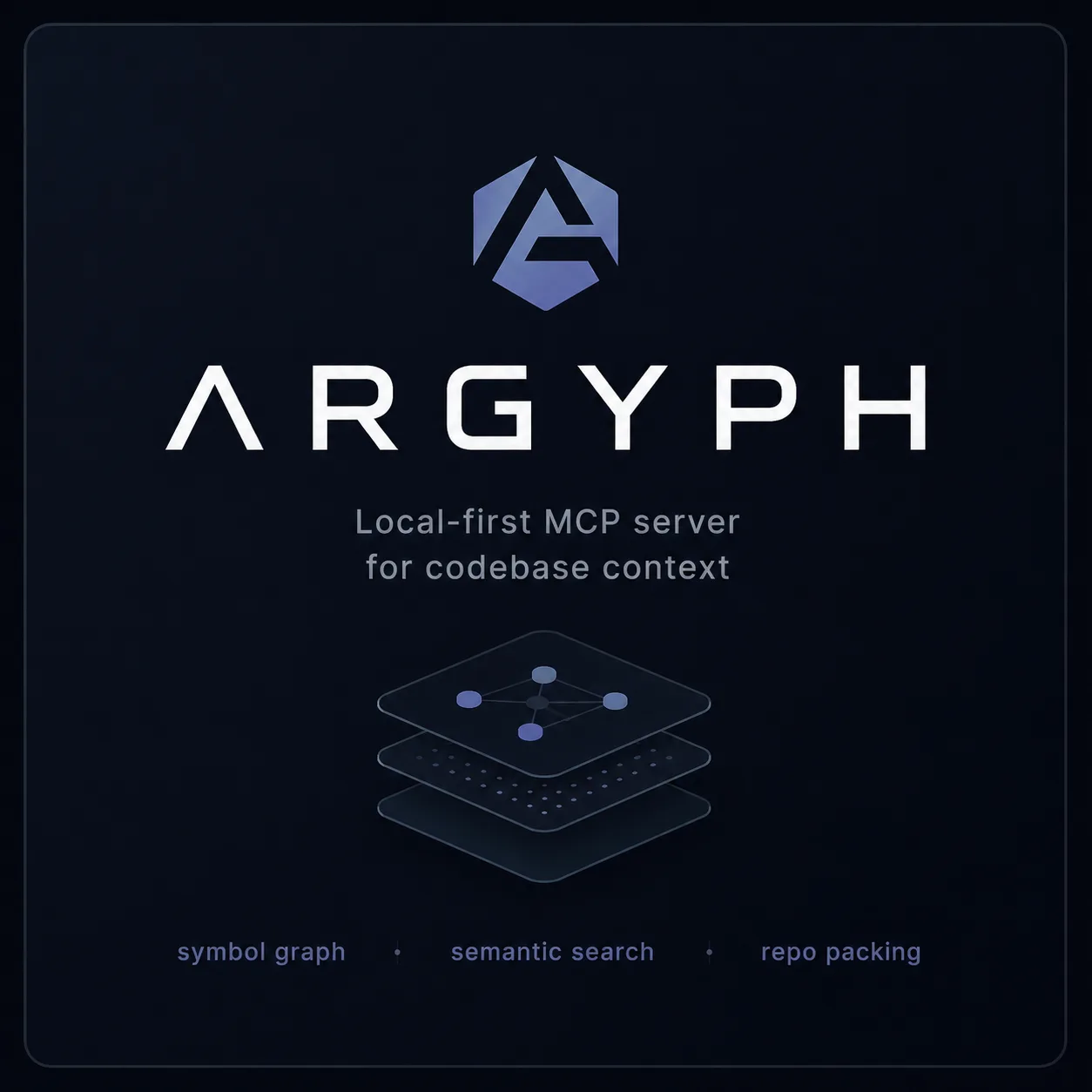
19 tools · tiered local index · public v1.0.4 release
Where it stands
Argyph is released as an MCP server and CLI through npm, crates.io, Homebrew, and downloadable binaries. Nineteen tools cover retrieval, symbols, repository packing, and local memory.
Scope and constraints
Retrieval runs locally. Indexing and memory tools maintain local state, so the full server should not be described as read-only. Semantic retrieval depends on index coverage.